Programming
Youth Soccer Strength Training Program: Age-Appropriate Guide for S&C Coaches
Evidence-based youth soccer strength training programs by age group (U12, U14, U16+). Covers safety research, maturation, and sample programming.

Mario Jovanovic
S&C coach · 7 min read
Youth Soccer Strength Training Program: What Actually Works by Age Group
There is more bad advice about youth strength training than almost any other topic in S&C. Parents worry it will "stunt growth." Club coaches think bodyweight circuits are enough. And too many young athletes show up at 16 with zero training history, expected to perform at a level their bodies are not prepared for.
Here is the reality: resistance training for young athletes is not only safe -- it is recommended by every major sports science body. The question is not whether youth soccer players should strength train. It is how to program appropriately for their developmental stage.
I have worked with players from U12 through senior level. The biggest regret I hear from older athletes is not starting structured training earlier. This guide covers what the research says, what works in practice, and how to build age-appropriate programs that develop robust, resilient young players.
What the Research Actually Says About Youth Strength Training
The NSCA published its position statement on youth resistance training in 2009 and reaffirmed it since. The key findings are clear:
- Resistance training is safe for youth when properly supervised and progressed
- There is no evidence that resistance training damages growth plates in healthy children when using appropriate loads
- Youth athletes who strength train have lower injury rates than those who do not
- Strength gains in pre-adolescent athletes are primarily neurological (better motor unit recruitment, not hypertrophy)
- Benefits include improved bone mineral density, body composition, motor skills, and sports performance
The British Journal of Sports Medicine, the American Academy of Pediatrics, and the International Olympic Committee have all published similar positions. The science is settled. The myth of "stunted growth" comes from outdated case studies involving child labour and maximal Olympic lifting without supervision -- not supervised, progressive training programs.
The real risk is not training. Untrained young athletes are more susceptible to overuse injuries, growth-related pain, and the sudden load spikes that come when they enter competitive environments without physical preparation.
Understanding Maturation: Why It Matters More Than Age
Two 14-year-olds can be at completely different developmental stages. One might look 12, the other could pass for 17. This is why chronological age alone is a poor guide for programming.
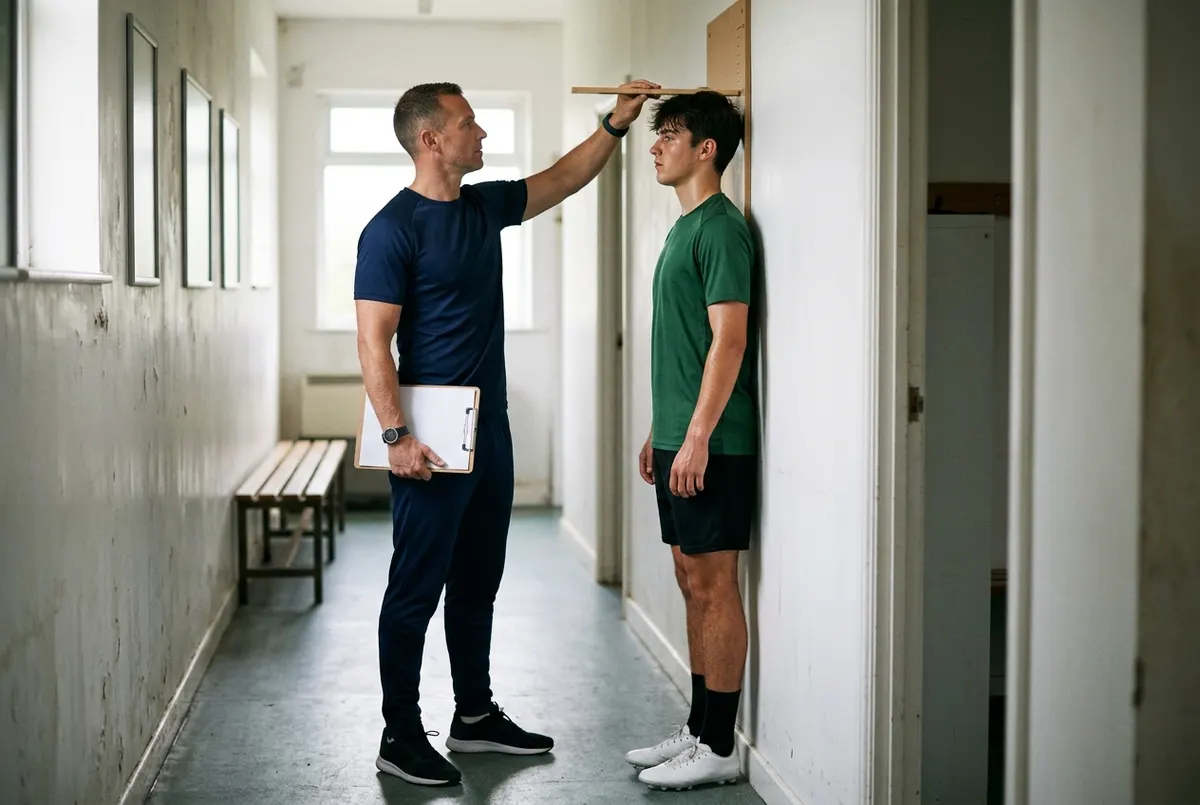
Peak Height Velocity (PHV) is the period of maximum growth rate during puberty, typically occurring between ages 11-13 for girls and 13-15 for boys. It matters for programming because:
- Pre-PHV: Neurological adaptations dominate. Focus on movement quality, coordination, and general physical literacy. Strength gains come from better movement patterns, not muscle growth.
- During PHV (circa-PHV): Rapid bone growth can outpace muscle and tendon adaptation. Adolescents are temporarily less coordinated. Injury risk increases. Reduce intensity, maintain movement quality, be patient.
- Post-PHV: The hormonal environment supports hypertrophy. Progressive loading becomes more appropriate. Athletes can begin to train more like adults -- with appropriate progression.
Practical Maturation Monitoring
You do not need lab equipment. Track standing height every 4-6 weeks. When a player is growing more than 0.5cm per month, they are likely in or approaching PHV. During this period:
- Reduce maximal loading
- Increase focus on mobility and movement quality
- Monitor for growth-related pain (Osgood-Schlatter, Sever's disease)
- Be more conservative with plyometric volume
Programming by Age Group
U12 (Pre-PHV): Movement Foundations
Goal: Physical literacy, coordination, love of training
Training frequency: 1-2 sessions per week, 30-40 minutes
What it looks like:
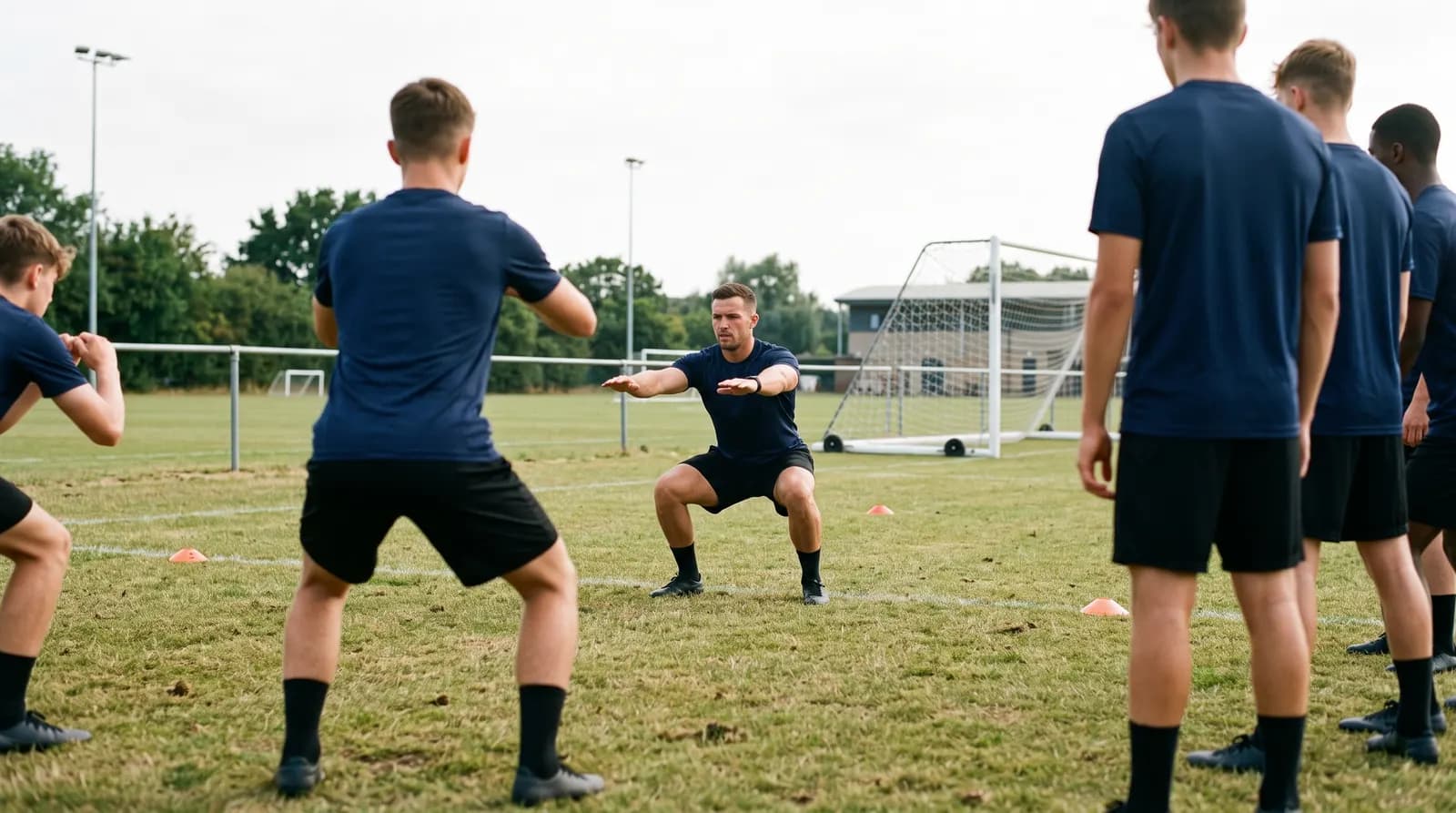
- Bodyweight movements: squats, lunges, push-ups, bear crawls, crab walks
- Light medicine ball throws and catches (1-2kg)
- Single-leg balance challenges, hop-and-stick landings
- Short sprints and change of direction games
- Animal movements and obstacle courses that disguise training as play
Sample Session (35 min):
- Dynamic warm-up with movement games (8 min)
- Bodyweight circuit: goblet squat (no load), push-up, lateral lunge, plank hold -- 2 rounds x 8 reps (10 min)
- Med ball partner throws: chest pass, rotational pass, overhead slam -- 2 x 6 each (8 min)
- Agility relay races (6 min)
- Cool-down stretching (3 min)
Key principle: Make it fun. If a 10-year-old dreads training, you have already lost. Competence and enjoyment at this age predict long-term adherence.
U14 (Circa-PHV): Building the Base
Goal: Movement competency under light load, introducing structure
Training frequency: 2 sessions per week, 40-50 minutes
What changes:
- Introduce external load: light dumbbells, kettlebells, resistance bands
- Teach barbell movements with an empty bar or technique bar
- Begin structured sets and reps (2-3 sets, 8-12 reps)
- Introduce basic periodization concepts (harder week, easier week)
- Add low-level plyometrics: box jumps onto soft surface, broad jumps
Sample Session (45 min):
- Dynamic warm-up (8 min)
- A1: Goblet squat -- 3x10 @ light KB A2: Push-up (or incline push-up) -- 3x8-12
- B1: DB Romanian deadlift -- 3x10 B2: Band pull-apart -- 3x12
- C1: Split squat -- 2x8 each leg C2: Plank -- 2x30s
- Broad jump -- 3x3 (focus on landing)
- Cool-down (5 min)
Key principle: Technique before load. Every rep should look good before adding weight. This is the age where movement habits are formed -- invest the time now.
U16+ (Post-PHV): Progressive Loading
Goal: Developing strength, power, and resilience for competitive soccer
Training frequency: 2-3 sessions per week, 45-60 minutes
What changes:
- Barbell movements with progressive loading: back squat, trap bar deadlift, bench press
- Structured periodization across training blocks
- Power development: loaded jumps, Olympic lift derivatives (hang clean, push press)
- Higher-intensity plyometrics: depth jumps, bounding
- Eccentric training: Nordic hamstring curls, Copenhagen adductors
- Sets of 3-6 for strength, 6-10 for hypertrophy depending on phase
Sample Session -- Strength Day (55 min):
- Dynamic warm-up + activation (10 min)
- A: Trap bar deadlift -- 4x5 @ 75-80% (strength focus)
- B1: Bulgarian split squat -- 3x8 each leg B2: DB bench press -- 3x8
- C1: Nordic hamstring curl -- 3x4-6 (eccentric focus) C2: Pallof press -- 3x10 each side
- D: Seated calf raise -- 2x15
- Cool-down (5 min)
Key principle: This is where real S&C begins. But the quality of movement established at U12 and U14 determines how quickly and safely a U16 player can progress.
Addressing Parent Concerns
Parents ask the same questions. Have clear answers ready.
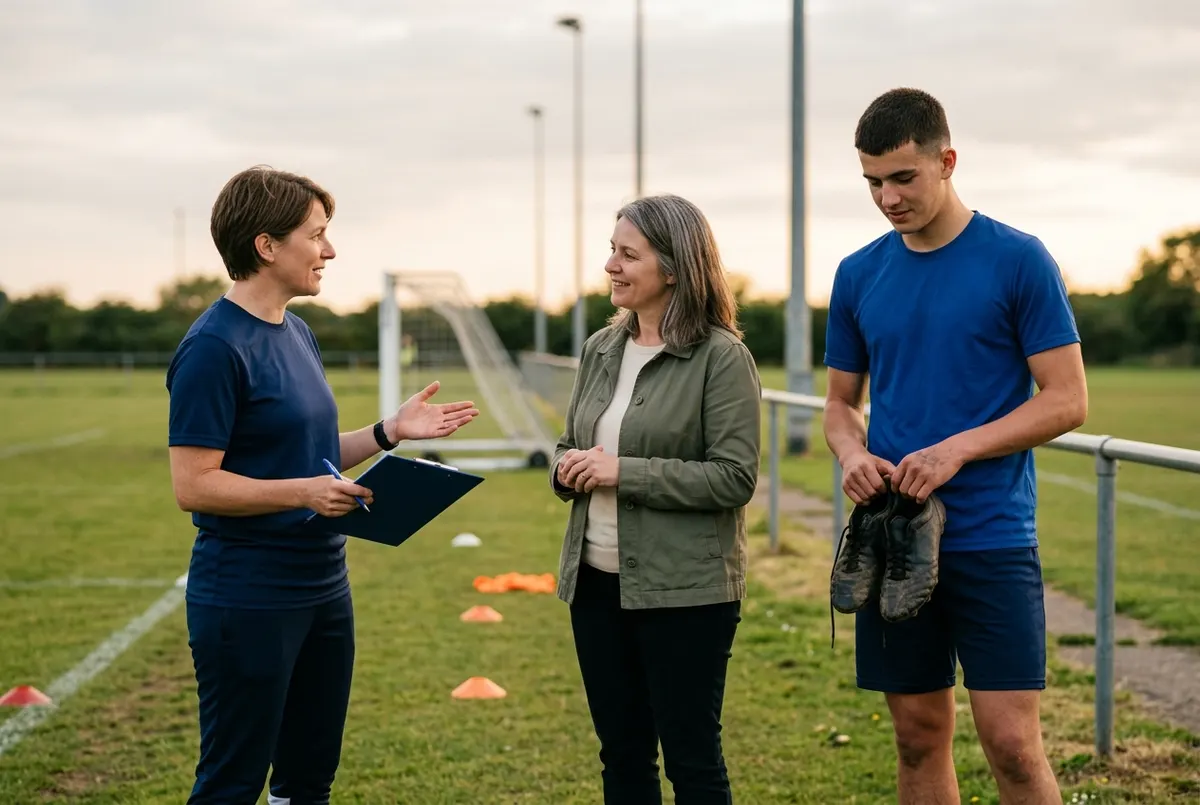
"Won't weights stunt their growth?" No. The NSCA, the AAP, and the IOC all confirm supervised resistance training is safe. Growth plate injuries come from accidents, not from a properly coached squat.
"They already train 4-5 times a week with their club." That is exactly why they need S&C. Repeated kicking, sprinting, and cutting without balanced strength development is how overuse injuries happen. S&C training is protective, not additional stress when programmed correctly.
"Can't they just do bodyweight stuff?" At younger ages, absolutely. But by U16, bodyweight alone is insufficient to develop the strength needed for competitive soccer. A 70kg athlete needs to move more than 70kg to get a meaningful strength stimulus.
"How do I know the coach is qualified?" Good question. Look for NSCA-CSCS, UKSCA, or ASCA accreditation. Ask about their experience with youth populations specifically. Ask what their progression model looks like.
Long-Term Athletic Development: The Big Picture
The LTAD framework matters because youth S&C is not about making 12-year-olds strong. It is about building a foundation that supports 10+ years of athletic development.
The progression looks like this:
- FUNdamentals (U6-U10): Movement literacy through play
- Learn to Train (U10-U13): Basic movement skills, introduce structure
- Train to Train (U13-U16): Build physical capacities, progressive loading
- Train to Compete (U16+): Sport-specific physical preparation
Every stage builds on the one before it. Skip the early stages and you spend years catching up later -- or worse, dealing with injuries that proper preparation would have prevented.
The best investment in a young player's athletic future is not more soccer. It is building a body that can handle the demands of the sport for years to come.
Managing training programs for young players across different age groups and maturation stages takes real organisation. This is one of the reasons I built PlayerPlan -- you can build age-appropriate session templates, track each player's training history, and share programs directly with players and parents through a simple link. No app downloads, no confusion. Try it free for 30 days at player-plan.com.
Ready to ditch the spreadsheets?
Session building, periodization, load monitoring and no-login player sharing — built for football S&C coaches.
Start your free 30-day trialPro features, AI included. No credit card.