Conditioning
Energy System Development for Football: The S&C Coach's Guide
How to program energy system development for football players. Aerobic base, anaerobic power, repeated sprint ability, and GPS zone training.

Mario Jovanovic
S&C coach · 12 min read
Energy System Development for Football: The S&C Coach's Guide
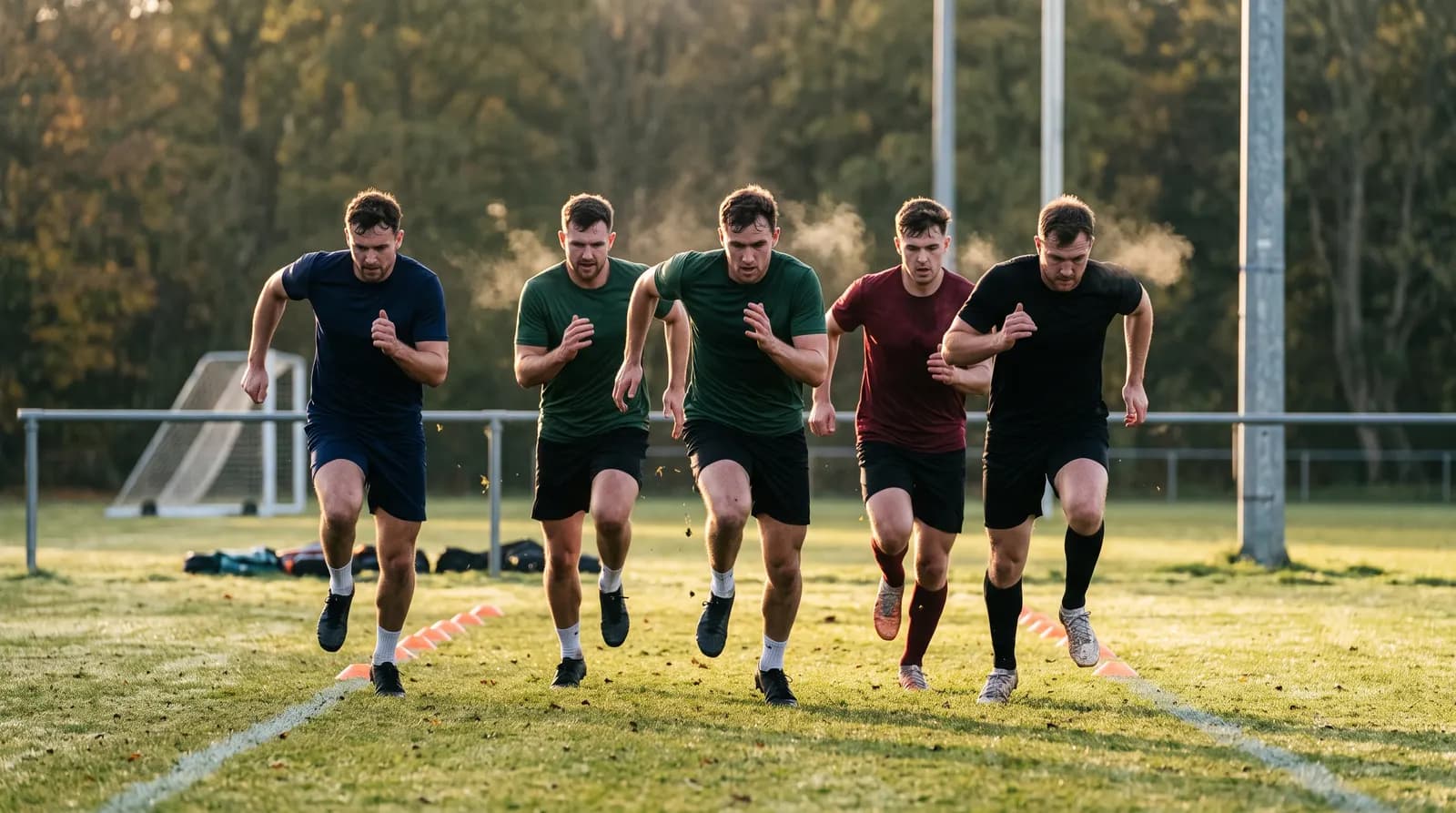
Minute 87. Your centre-back produces a recovery sprint at 31 km/h, wins the ball, and plays a 40-yard diagonal to start a counter-attack. Thirty seconds earlier, a different centre-back on a different team attempted the same sprint and came up 2 km/h short — enough for the attacker to beat him. The difference is not talent. It is energy system training for football, done properly across months of targeted programming.
Match data tells the same story at scale. A footballer covers 10-13 km per match, but within those kilometres they produce 150-250 brief, intense actions — sprints, decelerations, jumps, tackles, changes of direction. They hit 20-35 maximal sprints above 25 km/h, accumulate 600-1,100 metres of high-speed running above 19.8 km/h, and 200-400 metres of sprinting above 25.2 km/h (Bradley et al., 2009; Barnes et al., 2014). Recovery windows between efforts range from 2 seconds to 90 seconds.
What is energy system development for football? Energy system development (ESD) is the systematic training of the aerobic, glycolytic, and phosphagen energy pathways to match the intermittent, high-intensity demands of competitive football. It builds the aerobic engine that powers recovery between sprints, the glycolytic capacity that sustains pressing sequences, and the phosphagen system that fuels every explosive action across 90+ minutes.
If your conditioning programme looks like "go run for 30 minutes" or "do some shuttle runs at the end," you are leaving performance on the table. Targeted, position-specific energy system training produces better match outcomes than generic fitness work (Buchheit & Laursen, 2013; Iaia et al., 2009).
Here is how I approach ESD programming for footballers — the science behind each system, sessions you can implement immediately, and how it all fits into weekly and seasonal planning.
The Three Energy Systems (and Why All Three Matter)
You learned about ATP-PC, glycolytic, and oxidative systems in school. Here is what actually matters for football programming.
The Aerobic System: The Engine That Never Stops
The aerobic system provides roughly 80-90% of total energy during a football match (Bangsbo et al., 2006). That sounds surprising for a sport built on explosive actions, but consider: for every 2-4 second sprint, there are 40-70 seconds of jogging, walking, or standing. The aerobic system is what allows a player to recover between those high-intensity efforts.
Why it matters for football:
- Faster recovery between sprints — phosphocreatine resynthesis is oxygen-dependent, and a higher VO2max accelerates it (McMahon & Jenkins, 2002)
- Maintains decision-making quality in the final 15 minutes, when cognitive function degrades with fatigue
- Supports repeated high-intensity efforts across 90+ minutes
- Higher VO2max correlates with greater high-speed running distance in matches — Krustrup et al. (2005) showed that players above 60 ml/kg/min covered significantly more HSR metres than those below
A well-developed aerobic base does not make your player slow. It makes them capable of repeating fast actions for 90 minutes instead of 60.
The Glycolytic System: Sustained High-Intensity Efforts
The glycolytic system kicks in during efforts lasting roughly 10-90 seconds — a sustained pressing sequence, a repeated defensive recovery, an extended attacking transition. It produces ATP rapidly, but the byproducts (hydrogen ions causing intracellular acidosis, not "lactic acid" — that myth should be dead by now) contribute to acute fatigue and impair muscle contractile function.
Why it matters for football:
- Powers repeated high-intensity sequences (30-60 second pressing traps)
- Maintains intensity during congested periods of play
- Better glycolytic capacity means the player tolerates more high-intensity actions before quality degrades
- Improved buffering capacity (tolerance to hydrogen ion accumulation) delays peripheral fatigue during intense passages
The Phosphagen (ATP-PC) System: The Explosive Actions
Individual sprints, jumps, tackles, shots — any maximal effort lasting under 6-8 seconds. The ATP-PC system provides immediate energy but depletes within roughly 10 seconds of maximal work and needs 30-90 seconds for substantial recovery (about 50% restored in 30 seconds, 85% in 90 seconds).
Why it matters for football:
- Powers every sprint, change of direction, and explosive action
- Rate of phosphocreatine resynthesis is a key limiter of repeated sprint ability
- The quality of the 87th-minute sprint depends on how efficiently the player restores PC between efforts
Here is the key insight: the aerobic system restores the phosphagen system between sprints. A player with a better aerobic base recovers their sprint capacity faster (Girard et al., 2011). If you want better sprinting in the 80th minute, train the aerobic system. Everything is connected.
Aerobic Conditioning for Football: Methods and Programming
The aerobic base is where most of your conditioning volume should live — especially in off-season and pre-season. You are not training marathon runners. You are building the engine that powers recovery between sprints.
Two primary adaptations to target: central (increased cardiac output via stroke volume — a bigger pump) and peripheral (increased capillary density, mitochondrial volume, and oxidative enzyme activity at the muscle level). Different methods bias toward one or the other.
Methods
Tempo Runs / Continuous Running (120-150 bpm, 65-75% max HR) Steady-state running at a conversational pace. Not glamorous, but effective for building cardiac output and peripheral adaptations — capillary density, mitochondrial biogenesis, and improved fat oxidation.
- Duration: 20-30 minutes continuous
- Intensity: 65-75% max HR, or roughly 60-70% of maximum aerobic speed (MAS). If the player's MAS is 16 km/h, that is 9.6-11.2 km/h
- Frequency: 2-3 times per week in early off-season, dropping to 1x or zero in-season
- Best for: early off-season, players returning from injury, active recovery days
- Progression: Add 5 minutes per week up to 35-40 minutes before shifting to higher-intensity methods
Small-Sided Games (Aerobic Format) Manipulate player numbers, pitch size, and rules to keep heart rate in the aerobic zone. Larger pitches, more players, and possession-focused rules keep intensity moderate and sustained. Buchheit & Laursen (2013) showed that well-designed SSGs can replicate the cardiorespiratory demands of traditional interval training while embedding technical and tactical work.
- Format: 4v4 to 7v7 on oversized pitches (40x30m for 4v4, 60x40m for 6v6)
- Structure: 3-4 x 5-6 min bouts with 2 min active recovery between bouts
- Heart rate target: 80-90% max HR (higher than tempo runs but still primarily aerobic)
- Rules to manage intensity: minimum pass count before scoring, two-touch maximum, no pressing in own half
- Advantage: football-specific movement patterns with embedded technical work — easier to sell to the head coach
Long Intervals (85-92% max HR) Work bouts of 3-5 minutes with 2-3 minutes active recovery. This is where you drive VO2max adaptation most efficiently. The goal is to accumulate minutes at or above 90% of VO2max — what Buchheit calls "time at VO2max." Longer intervals beat short ones here because oxygen uptake takes 60-90 seconds to ramp up to near-max levels.
- Standard: 4-6 x 4 min at 90-95% MAS (85-92% max HR), 3 min recovery jog at 50-60% max HR
- Alternative: 3 x 6 min at 85-90% MAS (85-90% max HR), 3 min recovery
- Progression target: accumulate 16-24 minutes of total work time at >90% max HR
- Best for: pre-season development, mid-season maintenance (reduced volume)
Short Aerobic Intervals (85-105% MAS, 10-30s bouts) Often overlooked, but extremely useful for football. Intermittent runs at or above MAS with short recovery periods — for example, 10 seconds on, 10 seconds off. The short work bouts keep the player running at high speeds while brief recoveries prevent excessive lactate accumulation, keeping the stimulus primarily aerobic.
- Format: 2-3 sets of 8-12 reps of 10-15s at 100-105% MAS / 10-15s passive recovery
- Set rest: 3-4 minutes between sets
- Heart rate response: climbs progressively through the set, reaching 90-95% max HR by the final reps
- Best for: bridging the gap between base aerobic work and HIIT, mid-pre-season, and in-season maintenance where you want aerobic stimulus with minimal residual fatigue
Sample Aerobic Sessions
Off-Season Base Builder (Week 1-3):
- 5 min progressive jog warm-up
- 4 x 4 min at 90% MAS (controlled but uncomfortable — not conversational, not maximal)
- 3 min walk/jog recovery between intervals at 50% MAS
- 10 min cool-down jog
- Total: ~40 min. Peak HR should reach 88-92% max by the end of each interval.
Pre-Season Aerobic Development (Week 3-6):
- 5 min warm-up
- 5 x 4 min at 92-95% MAS
- 2.5 min recovery jog at 50% MAS
- 10 min cool-down
- Total: ~47 min. Target: 20 minutes accumulated at >90% max HR.
In-Season Maintenance:
- Small-sided games: 3 x 5 min (5v5, 40x30m pitch, minimum 4-pass rule before scoring)
- 2 min active recovery between bouts
- Heart rate target: 82-90% max HR
- Or: 2 sets of 10 x 15s at 100% MAS / 15s rest, 4 min between sets
- Can double as technical training — sell it to the head coach as tactical work with a conditioning benefit
When to Programme Aerobic Work
- Off-season (Weeks 1-4): Primary focus. 3-4 dedicated sessions per week. Emphasis on tempo runs and long intervals.
- Pre-season (Weeks 1-4): High priority alongside strength. 2-3 sessions. Shift from tempo runs toward long intervals and SSGs.
- Pre-season (Weeks 5-8): Shift toward higher-intensity methods. 1-2 aerobic sessions. Introduce short aerobic intervals.
- In-season: Maintenance only. 1 session per week, often embedded in pitch work (SSGs or short aerobic intervals).
For a deeper look at how aerobic conditioning for football fits into the seasonal plan, see the full breakdown in the periodization guide.
HIIT Training for Soccer Players: Matching Football's Demands
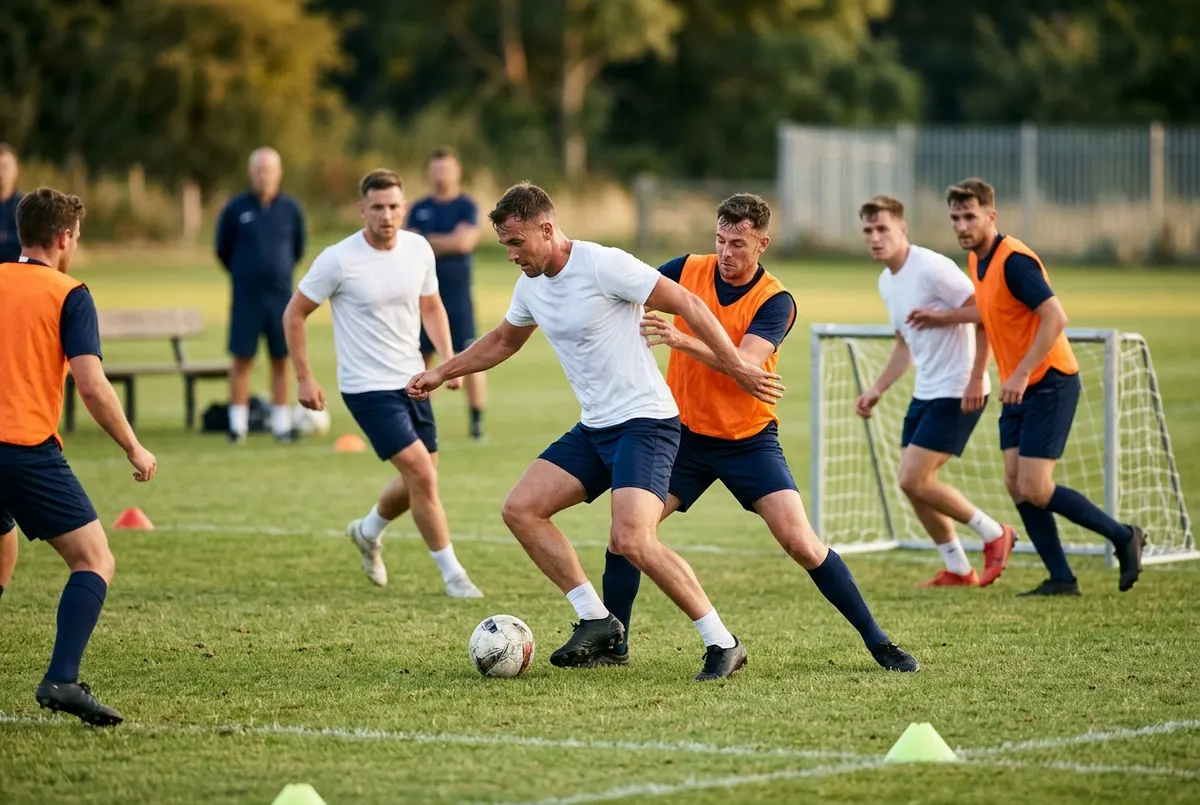
HIIT for football should look like football, not like a spin class. The work-to-rest ratios, effort durations, and movement patterns need to reflect what actually happens on the pitch.
Designing Football-Specific HIIT
Match analysis gives us clear targets:
- Sprint durations: 2-4 seconds on average, rarely exceeding 6 seconds (Di Salvo et al., 2009)
- High-intensity bouts: 10-30 seconds of sustained high effort (pressing, counter-attacking)
- Recovery between high-intensity actions: Highly variable — 15 seconds to 2+ minutes, median around 60 seconds
- Repeated sprint sequences: 3-6 sprints with less than 20 seconds recovery between them, occurring 5-10 times per match
This translates to clear programming targets:
Short Intervals (10-30 second work bouts)
- Work:rest ratio of 1:3 to 1:5
- Intensity: 95-100% max effort (>95% max speed for sprints, or >95% max HR for shuttle-based work)
- 6-10 reps per set, 2-3 sets, 3-4 minutes between sets
- Total sprint volume: 60-150 seconds of high-intensity work per session
- Targets: anaerobic power, VO2max (when accumulated with short rest), repeated effort ability
Medium Intervals (30-90 second work bouts)
- Work:rest ratio of 1:2 to 1:3 (e.g., 45s work, 90-135s rest)
- Intensity: 85-95% MAS (HR will climb to 90-95% max by end of each set)
- 4-6 reps per set, 2-3 sets, 4 minutes between sets
- Targets: glycolytic capacity, anaerobic threshold, aerobic power (these double as VO2max sessions when rest is kept short)
Sample HIIT Sessions
Short HIIT — Sprint-Based (Football-Specific):
- 10 x 15s sprint at 95% max effort
- 45s active recovery (walk/light jog) — work:rest = 1:3
- 3 min between sets
- 2 sets (total: 20 sprints, 300s of high-intensity work)
- Include 90-degree or 180-degree direction changes every 5 seconds — not straight-line running only
Medium HIIT — Tempo-Based:
- 6 x 45s at 90% MAS (hard enough that the player cannot speak in full sentences)
- 90s active recovery — work:rest = 1:2
- 2 sets, 4 min between sets
- Movement: shuttle runs (20m out, 20m back, repeat) or pitch-based patterns with acceleration and deceleration
Mixed HIIT — Simulating Match Demands:
- 30s at 90% max effort / 30s jog at 40% MAS / 15s sprint at 100% / 45s walk — repeat for 5 min
- 3 min passive recovery
- 3-4 sets
- Total high-intensity work: roughly 4-5 minutes spread across 15-20 minutes of session time
- Mimics the unpredictable work-rest patterns of actual match play
HIIT with Ball (SSG Format):
- 3v3 on a small pitch (25x20m), 3 min bouts, 2 min rest, 4-5 sets
- No touch restrictions — encourage high pressing intensity
- HR should reach 90-95% max within each bout
- The highest-intensity SSG format. Small player numbers force more actions per player.
Key Programming Considerations for HIIT
Intensity is non-negotiable. If your players are running at 70% during "high-intensity" intervals, you are training the wrong system. Use GPS live speed tracking, heart rate, or timed runs to verify intensity. A 15-second effort should feel like a 9/10 RPE. If you prescribe 95% MAS, the player should cover a known distance in a known time — no guessing.
Quality over quantity. When sprint times drop more than 5-10% from the best rep in the set, the stimulus shifts from speed/power development toward accumulated fatigue — junk volume. This is the decrement score concept from RSA testing applied to training. Stop the set or extend the rest.
Do not HIIT every day. High-intensity interval work creates significant neuromuscular and metabolic fatigue. Two sessions per week is the sweet spot during pre-season. In-season, matches are the primary high-intensity stimulus — you are supplementing, not replacing.
Separate HIIT from heavy lower-body training. If you programme squats and HIIT on the same day, do the HIIT at least 6 hours after the gym session (Robineau et al., 2016). Better yet, put them on separate days.
Repeated Sprint Ability Training: The Quality That Separates Levels
Repeated Sprint Ability (RSA) is the capacity to produce maximal or near-maximal sprint efforts with minimal recovery between them. It is arguably the most football-specific conditioning quality — and the one that separates competitive levels most clearly.
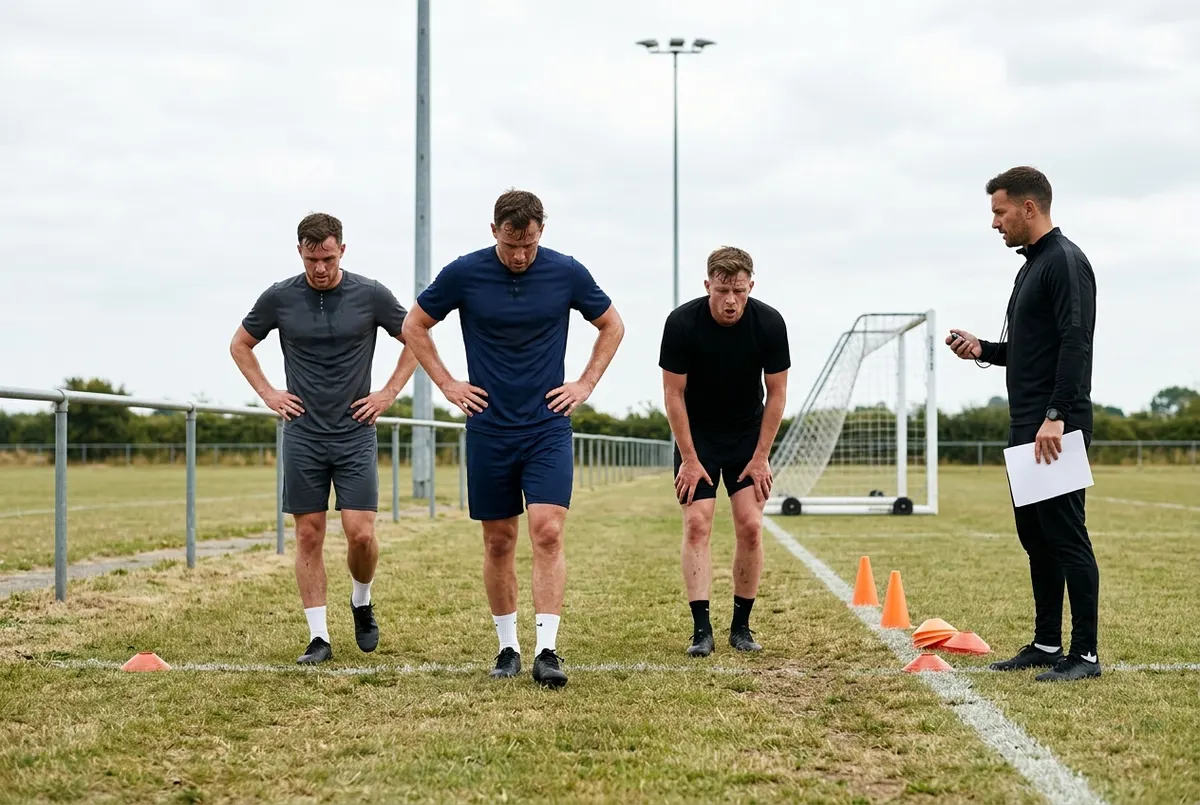
Watch any high-level match: a winger sprints to close down a full-back, recovers for 10 seconds, then sprints again to get in behind. A centre-mid presses three times in 20 seconds during a high press. A defender makes two recovery runs within 15 seconds.
Research confirms that repeated sprint ability training distinguishes higher-level footballers from lower-level ones (Rampinini et al., 2009), and that RSA performance declines more sharply than average running speed in the second half. RSA has two distinct determinants: peak sprint speed (the ceiling) and fatigue resistance (the ability to repeat near that ceiling). General HIIT improves the second but does little for the first — which is why dedicated RSA work with maximal-effort sprints is essential (Bishop et al., 2011).
How to Test RSA
The most widely validated protocol (adapted from Rampinini et al., 2007):
- 6 x 40m sprints with a 180-degree turn at 20m (out and back)
- 20 seconds passive recovery between sprints (standing at the start line)
- Record individual sprint times with timing gates or GPS (10 Hz minimum)
- Key metrics:
- Best sprint time — pure speed capacity
- Mean sprint time — total repeated sprint work capacity
- Fatigue index — percentage decline from best to worst: ((worst - best) / best) x 100
A fatigue index below 5% is excellent at the professional level. Between 5-8% is acceptable. Above 10% flags a player who needs dedicated RSA work.
How to Train RSA
RSA Protocol 1 — Standard:
- 6-8 x 30m sprints (straight line, standing start)
- 20s passive recovery (standing, no walking)
- 2-3 sets, 4 min passive rest between sets
- Intensity: maximal — every sprint is 100%. If the player is not at max effort, the stimulus is wrong.
RSA Protocol 2 — Short Distance, High Frequency:
- 10 x 20m sprints
- 15s passive recovery between reps
- 2 sets, 4 min between sets
- Shorter distance, shorter rest — preferentially stresses the rate of phosphocreatine resynthesis. The player never fully depletes but never fully recovers either.
RSA Protocol 3 — Football-Specific (with direction changes):
- 6 x 25m shuttle (12.5m out and back with a 180-degree turn)
- 20s passive recovery
- 2-3 sets, 4 min between sets
- The deceleration and re-acceleration adds eccentric load and makes this brutally football-specific. Monitor closely — the musculoskeletal cost is higher than straight-line sprints.
RSA Protocol 4 — Positional:
- Full-backs/wing-backs: 8 x 40m (longer sprints reflecting overlapping and recovery runs)
- Central midfielders: 10 x 20m with 15s rest (shorter, more frequent efforts matching their match profile — Di Salvo et al., 2007)
- Centre-backs: 6 x 30m with a 180-degree turn at 15m (recovery run simulation)
- Forwards/wingers: 6 x 35m with a curved run (simulating angled runs off the shoulder)
Progression for RSA
- Week 1-2: 2 sets of 6 reps, 25s recovery, 4 min between sets
- Week 3-4: 3 sets of 6 reps, 20s recovery, 4 min between sets
- Week 5-6: 3 sets of 8 reps, 20s recovery, 4 min between sets
- Week 7-8: 3 sets of 6 reps, 20s recovery — switch from straight-line to shuttle (add complexity, reduce volume)
The rule: progress by adding reps within sets first, then reducing rest, then adding sets or complexity. Never progress more than one variable at a time. Monitor sprint decrement across the block — if the fatigue index is not trending down, something is wrong (insufficient aerobic base, accumulated fatigue, or inadequate recovery between sessions).
GPS Velocity Zone Training: Using Data to Drive Conditioning
If you have GPS data — even consumer-grade units like Catapult, STATSports, or Playermaker — velocity zones transform your conditioning from guesswork to precision. Tim Gabbett's work on the training-injury prevention paradox (Gabbett, 2016) made one thing clear: you need to expose players to high-speed running in training to protect them from injury in matches. GPS zones give you the framework to quantify and prescribe that exposure.
The Standard Velocity Zone Model
Most GPS providers use a 5-6 zone model. Here is the standard absolute threshold model used by STATSports and Catapult:
| Zone | Name | Typical Threshold | Football Context |
|---|---|---|---|
| 1 | Walking | 0-6 km/h | Standing, walking between plays |
| 2 | Jogging | 6-12 km/h | Light recovery movement, repositioning |
| 3 | Running | 12-18 km/h | Moderate-intensity movement, tactical positioning |
| 4 | High-Speed Running (HSR) | 18-21 km/h | High-intensity positional play, closing space |
| 5 | Sprinting | 21-25.2 km/h | Fast breaks, recovery runs at near-max effort |
| 6 | Max Sprinting | >25.2 km/h | Maximal sprints, counter-attacks, breakaways |
The HSR threshold at 19.8 km/h (5.5 m/s) is the most common in the research literature, though some systems default to 18 or 21 km/h. Stay consistent with your threshold — do not compare data across different definitions.
Individualising Thresholds
Here is where many coaches go wrong: using absolute thresholds for every player. A winger with a max speed of 33 km/h and a centre-back at 28 km/h register very different zone profiles at the same thresholds. The winger could run at 80% of max and register in Zone 5, while the centre-back at 80% barely enters Zone 4.
The better approach: Set thresholds as percentages of individual maximum sprint speed (MSS).
| Zone | Threshold (% MSS) | Example: Player A (MSS = 33 km/h) | Example: Player B (MSS = 28 km/h) |
|---|---|---|---|
| 4 (HSR) | 60-75% MSS | 19.8-24.8 km/h | 16.8-21.0 km/h |
| 5 (Sprint) | 75-90% MSS | 24.8-29.7 km/h | 21.0-25.2 km/h |
| 6 (Max Sprint) | >90% MSS | >29.7 km/h | >25.2 km/h |
How to establish MSS: Run 3 x 40-50m flying sprints (10m acceleration zone, 30-40m timing zone) with full recovery (2-3 minutes). Take the highest recorded GPS speed. Re-test every 4-6 weeks during pre-season, every 8-12 weeks in-season. MSS can shift 1-3% across a season, so thresholds need updating.
For Zones 1-3, absolute thresholds work fine — the physiological significance of individualising walking and jogging speeds is minimal. Focus individualisation on Zones 4-6, where the training and injury implications are greatest. I go deeper into individualised threshold setting and GPS-driven programming on MJ Perform.
Using GPS Data to Prescribe Conditioning
Match GPS data gives you targets. If your right-back covers 950m of high-speed running in a competitive match, your conditioning sessions should progressively build toward that capacity so match demands never exceed what the player is prepared for.
Step 1: Establish match demands by position. Track 3-5 competitive matches and calculate the average and peak values for each position group:
- Total distance (typically 9.5-12.5 km, midfielders at the high end)
- HSR distance (typically 500-1,100m, wide players and full-backs at the high end)
- Sprint distance (typically 150-400m, forwards and wide players highest)
- Number of high-intensity accelerations and decelerations (>2.5 m/s^2)
- Peak speed achieved
Step 2: Set weekly training targets. Gabbett's work suggests that in-season training should expose players to roughly 70-85% of match-day HSR demands across the training week (excluding the match). If a full-back covers 900m of HSR in a match, aim for 630-765m of HSR across training days that week.
Step 3: Distribute the load across the week. Not all HSR is equal in recovery cost. Assign the highest-speed work (Zone 5-6) to MD-4 or MD-2, and keep MD-1 and MD+1 below Zone 4. A sample distribution for a 700m weekly HSR target:
| Day | HSR Target | Session Type |
|---|---|---|
| MD-4 (Tuesday) | 250-300m HSR | Long intervals or SSGs |
| MD-3 (Wednesday) | 100-150m HSR | Incidental from gym-based power work |
| MD-2 (Thursday) | 250-300m HSR | RSA or short HIIT |
| MD-1 (Friday) | <50m HSR | Activation only |
Step 4: Monitor the acute:chronic workload ratio. Track rolling 7-day versus 28-day averages of total distance, HSR distance, and sprint distance. Gabbett (2016) showed that players whose ACWR exceeds 1.5 face significantly elevated injury risk, while those in the 0.8-1.3 range are relatively protected. Use this to make real-time decisions about conditioning volume. For a full guide to ACWR monitoring, see our workload monitoring guide.
PlayerPlan's Energy System Builder includes GPS velocity zone presets from Catapult, STATSports, and Playermaker — so you can design conditioning sessions with accurate zone targets built in. Set individual player thresholds once based on MSS, and every energy system session automatically adjusts the zone boundaries. No spreadsheet required.
Weekly Programming: Where ESD Fits in the MD-Minus Framework
The MD-minus (Match Day minus) framework organises the training week around the next match. Every day has a purpose, and energy system work needs to slot into the right day to avoid interfering with other qualities or creating residual fatigue before match day.
Single Match Week (Match on Saturday)
| Day | MD Label | Primary Focus | ESD Slot |
|---|---|---|---|
| Sunday | MD+1 | Recovery / Off | ✗ No conditioning — pool recovery, flush ride, or off |
| Monday | MD-5 | Low-intensity aerobic, light technical | Tempo run 20-25 min at 65-70% max HR, or regeneration SSG (6v6+, large pitch, low pressing) |
| Tuesday | MD-4 | Strength (hypertrophy or maximal) | Long aerobic intervals if needed (4x4 min), separated from gym by 6+ hours. Or: aerobic SSGs post-pitch |
| Wednesday | MD-3 | Strength/power emphasis | ✗ No dedicated ESD — CNS recovery priority. Any conditioning is incidental from pitch work. |
| Thursday | MD-2 | Speed, agility, explosive power | RSA or short HIIT — the primary high-intensity ESD day. 20-25 min total including warm-up. |
| Friday | MD-1 | Activation, tactical walk-through | ✗ No ESD — low volume, stay fresh. Total session under 40 min. |
| Saturday | MD | Match | The ultimate energy system session — 90 min of intermittent high-intensity work |
Double Match Week (Saturday + Tuesday/Wednesday)
Congested weeks change everything. No time for dedicated ESD, and the priority shifts entirely to recovery and readiness.
| Day | Context | ESD? |
|---|---|---|
| Saturday | Match 1 | — |
| Sunday | MD+1 / MD-3 | Off or pool recovery only |
| Monday | MD-2 for Match 2 | Light activation, tactical. No ESD. |
| Tuesday | Match 2 | — |
| Wednesday | MD+1 | Off or recovery |
| Thursday | MD-2 for next match | Short RSA (1 set of 6 only) if fitness is a concern, otherwise speed/agility only |
| Friday | MD-1 | Activation only |
In double match weeks, two competitive matches provide more than enough high-intensity stimulus. Your job is to manage fatigue, not add to it.
Key Scheduling Principles
MD-4 for longer conditioning sessions. If you need a 40-minute aerobic session or medium HIIT, do it early in the week when there are 3+ days to recover before the match.
MD-2 for short, explosive work. RSA protocols and short HIIT (work bouts under 15 seconds) fit well on MD-2 because they are neuromuscularly demanding but recover within 48 hours. Keep total high-intensity volume under 25 minutes.
Never programme heavy ESD on MD-1. The player needs to arrive at the match with fully restored glycogen and minimal residual neuromuscular fatigue. MD-1 is for tactical review and neural priming only.
The match is the best conditioning session. A 90-minute match provides 600-1,100m of high-speed running, 20-35 sprints, and massive cardiac output demands. In-season, the match itself maintains most conditioning qualities. Your job is to fill the gaps (targeted RSA, aerobic maintenance) and manage the load around it.
For more on structuring the in-season training week around matches, see the in-season training guide.
Building energy system sessions around the MD-minus framework is exactly what PlayerPlan's session builder is designed for. Drag and drop conditioning blocks into your weekly plan, assign GPS zone targets, set work-to-rest ratios, and see the total load accumulate across the week — all in one view. Start building your weekly plan free.
Progression Model: How to Progress Energy System Training Across a Block
Energy system training for football, like strength training, needs progressive overload. But the variables differ, and the principle of specificity means the nature of the overload should shift as the season approaches.
The Progression Variables (in order of priority)
- Volume: Total work time or total high-speed distance (e.g., 16 min to 20 min of interval work, or 400m to 600m of HSR)
- Recovery: Decrease rest periods between efforts (e.g., 25s to 20s between RSA sprints)
- Intensity: Increase speed, effort percentage, or HR targets (e.g., 90% MAS to 95% MAS)
- Density: More work in the same total session time (e.g., 4 x 4 min with 3 min rest becomes 5 x 4 min with 2.5 min rest — both volume and rest change)
- Complexity: Add direction changes, cognitive load, reactive decision-making, or ball work
The rule: change one variable per week, two at most. Increasing volume and reducing rest while adding direction changes is a recipe for overuse injury. Gabbett's acute:chronic workload research (Gabbett, 2016) shows that large week-to-week spikes — more than 10-15% — significantly elevate injury risk. The ACWR monitoring guide covers the practical mechanics in detail.
Sample 6-Week Aerobic Block (Pre-Season)
| Week | Session | Volume | Intensity | Recovery | Notes |
|---|---|---|---|---|---|
| 1 | 4 x 4 min intervals | 16 min work | 90% MAS / ~85% max HR | 3 min jog at 50% MAS | Establish baseline HR response |
| 2 | 4 x 4 min intervals | 16 min work | 92% MAS / ~87% max HR | 3 min jog | Intensity up, volume same |
| 3 | 5 x 4 min intervals | 20 min work | 92% MAS / ~87% max HR | 3 min jog | Volume up, intensity holds |
| 4 | 5 x 4 min intervals | 20 min work | 92% MAS / ~88% max HR | 2.5 min jog | Rest down, volume holds |
| 5 | 5 x 4 min intervals | 20 min work | 95% MAS / ~90% max HR | 2.5 min jog | Intensity peak |
| 6 | DELOAD: 3 x 4 min | 12 min work | 90% MAS / ~85% max HR | 3 min jog | 40% volume reduction |
Sample 4-Week RSA Block (Pre-Season, Weeks 5-8)
| Week | Sets x Reps | Distance | Recovery | Fatigue Index Target | Notes |
|---|---|---|---|---|---|
| 1 | 2 x 6 | 30m straight | 25s passive | Establish baseline | Record all individual sprint times |
| 2 | 2 x 6 | 30m straight | 20s passive | <8% | Rest reduced — same volume |
| 3 | 3 x 6 | 30m straight | 20s passive | <7% | Volume up (added set) |
| 4 | 3 x 6 | 25m shuttle (12.5m + turn) | 20s passive | <8% (harder with COD) | Complexity up — accept higher FI initially |
Sample In-Season Maintenance Block (4-Week Cycle)
| Week | Monday (MD-5) | Thursday (MD-2) |
|---|---|---|
| 1 | Tempo run: 25 min at 65-70% max HR | RSA: 2 x 6 x 30m, 20s rest, 4 min between sets |
| 2 | SSG aerobic: 3 x 5 min 5v5, 2 min rest (target 82-88% max HR) | Short HIIT: 2 x (8 x 15s sprint / 45s recovery), 3 min between sets |
| 3 | Short aerobic intervals: 2 x (10 x 15s at 100% MAS / 15s rest), 4 min set rest | RSA: 2 x 8 x 20m, 15s rest, 4 min between sets |
| 4 | DELOAD: 15 min easy jog at 60% max HR | DELOAD: 1 x 6 x 30m RSA only |
Addressing the "Conditioning Kills Gains" Myth
I hear this constantly from coaches who came from a pure strength background: "If I run my players, I will kill their strength gains." The interference effect. Concurrent training. The classic worry.
Here is what the evidence actually says:
Yes, there is an interference effect — but it is context-dependent. Hickson (1980) showed that heavy endurance training can blunt strength and power gains. But "heavy endurance training" in that study meant 30-40 minutes of running at high intensity, 6 days per week, stacked on top of 5 days of heavy strength training. No football S&C coach would prescribe that combined volume.
The interference effect is primarily a volume and proximity problem. The Wilson et al. (2012) meta-analysis found that running interferes with lower-body hypertrophy and maximal strength more than cycling, but the effect was dose-dependent. Moderate volumes — 2-3 sessions per week, 20-30 minutes per session — did not significantly impair strength gains when adequate recovery was provided. Robineau et al. (2016) showed that separating strength and endurance sessions by 6+ hours effectively eliminated the acute interference on neuromuscular performance.
Football conditioning volumes sit well below the interference threshold. Your players are doing 2-3 targeted sessions per week, totalling 40-60 minutes of actual work time. Compare that to 6+ hours of weekly running in studies that found significant interference. At football-relevant volumes, the effect is minimal to non-existent.
The aerobic base actually supports strength training recovery. A well-conditioned aerobic system clears metabolites faster between sets, supports glycogen resynthesis post-session, enhances parasympathetic recovery (accelerating HRV restoration between sessions), and improves sleep quality (Tomlin & Wenger, 2001). Players with better aerobic fitness recover faster from heavy gym sessions. Every time I have improved a player's aerobic base, their ability to tolerate gym volume has increased — not decreased.
The practical takeaway: Do not avoid conditioning because you fear losing strength gains. Programme it intelligently — separate high-intensity conditioning from heavy lower-body strength by at least 6 hours or put them on different days, keep volumes moderate (under 30 minutes of high-intensity work per session), and prioritise quality over volume. When in doubt, apply Buchheit's principle: do the minimum effective dose that maintains or improves the quality you are targeting.
Putting It All Together
Energy system development for football is not one thing — it is a layered system where aerobic capacity supports repeated sprint ability, glycolytic capacity sustains high-intensity sequences, and the phosphagen system powers every explosive action. The aerobic system underpins everything.
Programming priorities shift across the season:
- Off-season (4-6 weeks): Aerobic base is king. Build the engine. 3-4 sessions per week of tempo runs, long intervals, and SSGs. Introduce short aerobic intervals in weeks 3-4.
- Pre-season early (weeks 1-4): Continue aerobic development with long intervals and SSGs, introduce HIIT progressively. Test RSA to establish baselines.
- Pre-season late (weeks 5-8): Shift to RSA and football-specific HIIT. Reduce aerobic volume to 1 session per week. Conditioning becomes match-specific here.
- In-season: Maintenance mode. The match does most of the work. Supplement with 1-2 targeted sessions per week in the MD-minus framework — typically one aerobic session (MD-5) and one high-intensity session (MD-2). Structure those within a solid periodization plan and monitor loads with ACWR tracking to keep injury risk low.
Test regularly. An RSA test every 4-6 weeks gives you objective data on whether your conditioning programme is working. Track the fatigue index over time — if it is not trending down, either address the aerobic base (if recovery between sprints is the issue) or sprint speed itself (if the ceiling is too low).
Use GPS data to close the feedback loop. Compare weekly training HSR and sprint distances against match demands. If your full-back covers 900m of HSR in matches but only accumulates 300m in training, the gap is too large and injury risk spikes when match demands increase. If training HSR consistently exceeds match demands, you are overloading unnecessarily.
Always track load in context. Every conditioning session adds training stress. If your player's ACWR is already 1.4 from a congested match schedule, the last thing they need is an extra HIIT session on Monday. Load monitoring and conditioning programming are two sides of the same coin — you cannot do one well without the other.
PlayerPlan's Energy System Builder was purpose-built for this work. Design conditioning sessions with GPS velocity zone targets, set work-to-rest ratios, track accumulated high-speed running metres across the week, and see how every session impacts your player's load profile. Drag, drop, and prescribe — no spreadsheet gymnastics required. Build your first energy system session free.
Ready to ditch the spreadsheets?
Session building, periodization, load monitoring and no-login player sharing — built for football S&C coaches.
Start your free 30-day trialPro features, AI included. No credit card.