Load & monitoring
In-Season Training for Soccer Players: How to Maintain Strength Without Adding Fatigue
How to program in-season strength training for soccer players. Match-day minus framework, load management, and minimum effective dose approach.

Mario Jovanovic
S&C coach · 7 min read
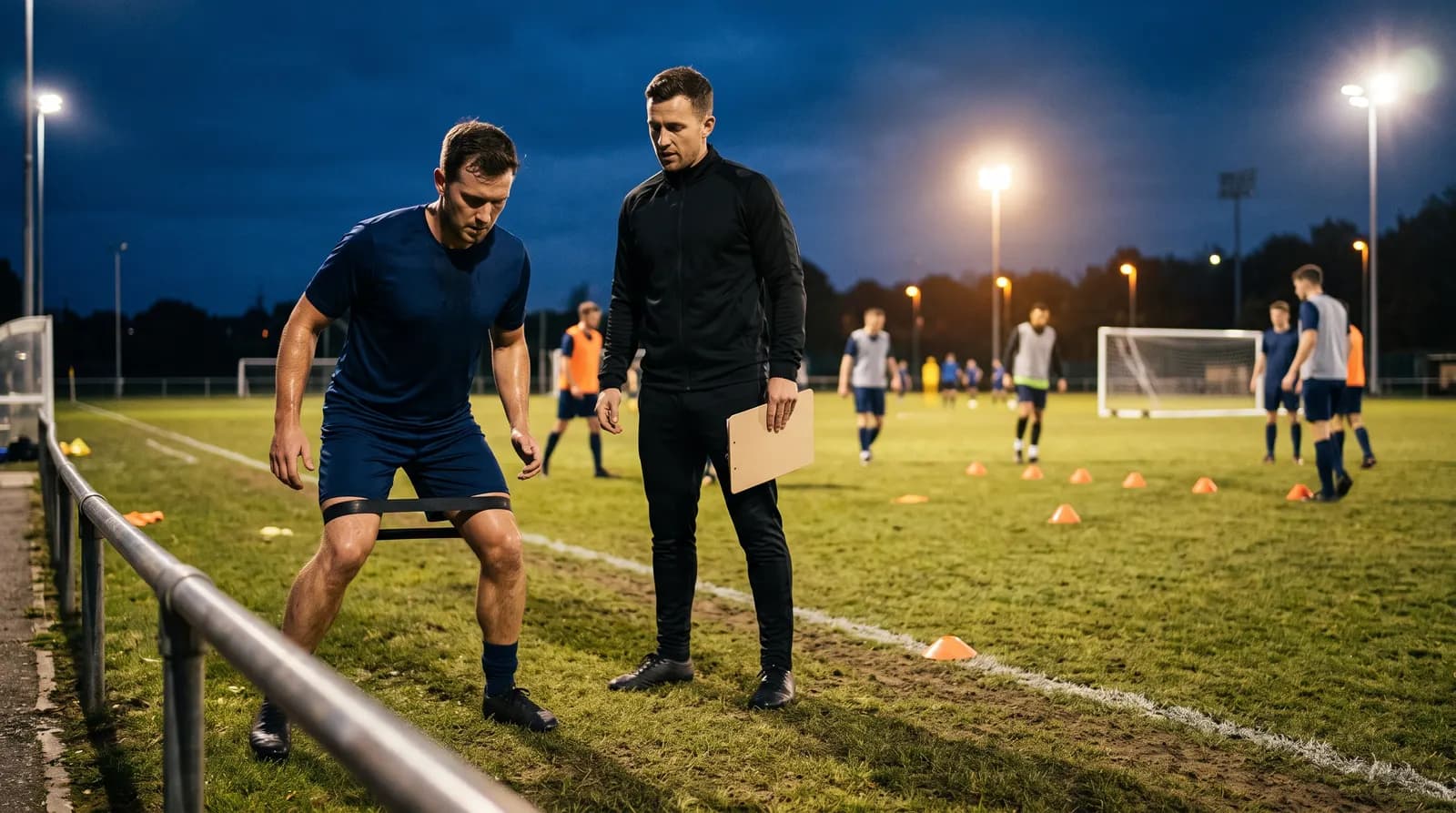
In-Season Training for Soccer Players: Maintaining Strength Without Killing Them
The in-season period is where most S&C programs fall apart. Club coaches worry about fatigue. Players feel sore and skip sessions. The S&C coach either backs off completely or stubbornly sticks to an off-season plan and wonders why everyone is tired by match day.
The challenge is real: your players are already training 4-6 times per week with their club, playing 1-2 matches, and living the rest of their lives on top of that. Adding strength work cannot create more fatigue than it removes.
But dropping strength training entirely is not the answer either. Research consistently shows that players who stop resistance training during the season lose significant strength -- up to 10% of their squat strength within 4-6 weeks. That lost strength means less power, less speed, and a higher injury risk as the season progresses.
The solution is not less training. It is smarter training.
The Match-Day Minus Framework
The match-day minus (MD-) system organises the training week around the match, not around a fixed schedule. Every session is defined by its relationship to the next game. I've written a comprehensive guide to the match-day minus framework that covers every detail, but here's the practical summary for in-season strength work.
This is how most professional clubs structure their weeks, and it works just as well for independent players -- you just need to know when their match is.
The Framework
MD-4 (Four days before match): Strength / Heavy This is the day with the most distance from the match, so it tolerates the highest mechanical load. Think compound lifts at moderate-to-heavy loads, lower volume.
- Trap bar deadlift: 3x4 @ 80-85%
- Bulgarian split squat: 3x6 each
- Nordic hamstring curl: 3x4-5
- Bench press or DB press: 3x6
- Core: Pallof press, anti-rotation work
Total session: 35-45 minutes. Get in, get the stimulus, get out.
MD-3 (Three days before match): Power / Speed Neuromuscular priming without significant muscle damage. Short, explosive, low volume.
- Loaded jumps or hang cleans: 4x3
- Banded hip thrusts: 3x5 (explosive)
- Plyometrics: hurdle hops, depth jumps -- 3x4
- Short sprints: 4x20m
Total session: 25-35 minutes. The player should leave feeling sharp, not fatigued.
MD-2 (Two days before match): Tactical focus / Light Lower physical load. If any gym work happens, it is accessory work only -- mobility, prehab, light core. The priority is tactical preparation on the pitch.
MD-1 (Day before match): Activation Only If anything at all. Some coaches prefer complete rest, others do a light 15-minute activation circuit. This is not a training session -- it is a wake-up call for the nervous system.
- Glute bridges, banded walks, light mobility
- 3-4 short accelerations (10-15m)
- Keep it under 15 minutes
MD+1 (Day after match): Recovery Pool session, light bike, stretching, foam rolling. The goal is to promote blood flow without adding mechanical stress. No lifting.
MD+2: Return to training. This often becomes the next MD-4 in a single-match week, and the cycle repeats.
Two-Match Weeks
When a player has two matches in a week (common during cup runs or fixture congestion), something has to give. You cannot fit a heavy strength session between two matches with only 48 hours of separation.
Options:
- One reduced session on the day with the most distance from both matches, using lighter loads (65-70%) and lower volume (2x5 instead of 3x5)
- Skip the gym entirely and use that day for recovery + activation only
- Accept the deload. A forced recovery week every few weeks is not the worst thing
The key decision: is one reduced session better than nothing? Almost always, yes. Even 20 minutes of submaximal lifting maintains neuromuscular qualities better than nothing.
Managing Training Load Alongside Club Sessions
This is the hardest part of working with independent players: you rarely control their full training week. They show up to club training, do whatever the club coach has planned, and then come to you.
The Problem You Cannot Ignore
If a player does a high-intensity SSG session with their club on Tuesday, and you have a heavy deadlift session planned for Wednesday, you are stacking two high-stress days back-to-back. That is how hamstrings get pulled.
What Actually Works
1. Know the club schedule. Get it every week. Even approximate information ("hard session Tuesday, light Thursday") is better than guessing.
2. Track external load. Have your players log their club sessions -- duration, RPE, and type. This takes 30 seconds after each session and gives you the data to make informed decisions. Even simple session-RPE (duration x RPE) reveals weekly load patterns.
3. Adjust in real-time. If a player reports a club session RPE of 9 the day before your planned heavy session, you modify. Drop the intensity, reduce volume, or shift to a neural-focused power session instead. Rigid programming in-season gets people hurt.
4. Monitor the acute:chronic workload ratio (ACWR). Keep the ratio between 0.8 and 1.3. Spikes above 1.5 are where injury risk climbs significantly. This requires consistent tracking, but it is the best objective measure you have for readiness.
Common In-Season Mistakes
Mistake 1: Dropping Strength Work Entirely
"We will just focus on football." This is what happens when clubs or players see S&C as optional. Within 4-6 weeks, strength drops. By week 10, they are weaker, less powerful, and more injury-prone than at the start of the season. The research from Ronnestad et al. and others is clear: maintaining strength requires training. Not as much as building it, but you cannot maintain what you do not stimulate.
Mistake 2: Running the Off-Season Program During the Season
The off-season might be 4 sessions per week, high volume, with hypertrophy blocks and dedicated conditioning days including structured energy system development work. Trying to maintain that intensity alongside 5 club sessions and a match is a recipe for overtraining. The in-season program should look fundamentally different -- fewer sessions, lower volume, higher relative intensity on the key lifts, and almost no isolated conditioning work (they are getting plenty from football).
Mistake 3: Only Training When the Player Feels Good
Readiness-based training has its place, but if a player only trains when they feel perfect, they will train twice a month during the season. There is always a match to recover from or prepare for. The minimum effective dose approach (below) solves this by making sessions short enough that they are almost always tolerable.
Mistake 4: Ignoring Eccentric Work
Eccentric strength is the single most protective quality for hamstring injuries, which spike during the in-season period. Nordic hamstring curls, Romanian deadlifts, and eccentric-focused tempo work should remain in every in-season program. Drop other things first.
The Minimum Effective Dose Approach
In-season training is about finding the smallest stimulus that maintains physical qualities. Not the best stimulus. Not the most complete program. The minimum that works.

What the Research Supports
- 1-2 strength sessions per week maintains strength levels established in the off-season
- 2-3 sets per exercise (not 4-5) provides sufficient stimulus for maintenance
- Relative intensity stays high (75-85% 1RM) but volume drops significantly
- Session duration of 30-45 minutes is realistic alongside a full training and match schedule
A Practical In-Season Template
Session A (MD-4) -- Lower Body Emphasis
- A1: Trap bar deadlift -- 3x4 @ 80%
- B1: Bulgarian split squat -- 3x6 each
- B2: Nordic hamstring curl -- 3x5
- C1: Copenhagen adductor -- 2x8 each side
- C2: Single-leg calf raise -- 2x12
Session B (MD-3, or second session if two available) -- Upper + Power
- A1: Hang clean or jump squat -- 4x3 @ light
- B1: DB bench press -- 3x6
- B2: Band pull-apart -- 3x15
- C1: Chin-up -- 3x6-8
- C2: Pallof press -- 3x10 each
Each session takes 35 minutes. A player doing both sessions each week is investing just over an hour in the gym. That is enough to maintain strength, support injury prevention, and keep the player robust through a long season.
Tracking Makes the Difference
In-season programming without load monitoring is guesswork. You need to know:
- What the player did with their club this week
- How they are feeling (wellness data: sleep, soreness, energy)
- Whether their total weekly load is within a safe range
- If they are approaching an ACWR spike
This data does not need to be complicated. Simple session-RPE logging and a weekly wellness check-in give you enough information to make good decisions. The coaches who get in-season training right are not the ones with the cleverest programs -- they are the ones who adjust based on what is actually happening.
In-season load management is why I built external load tracking and ACWR monitoring into PlayerPlan. Your players log their club sessions in 30 seconds, you see their full weekly load picture, and you can adjust programming before problems develop. Try it free for 30 days at player-plan.com.
Ready to ditch the spreadsheets?
Session building, periodization, load monitoring and no-login player sharing — built for football S&C coaches.
Start your free 30-day trialPro features, AI included. No credit card.