
Programming Around Club Training You Don't Control
How to Program Soccer Players Around Club Training You Don't Control
You wrote a clean MD-3 lower-body session. Then the club ran a 90-minute small-sided game block on Thursday that nobody told you about, and your player walked into the gym already cooked. If you coach soccer/football players outside the club, you do not own the week. You own the part of the week that actually gets individualised.
What does it mean to program around club training? It means treating every pitch session, gym circuit, and match the club runs as load you must account for before you prescribe a single set. You capture duration and RPE, map that session onto the same MD-minus week as your gym work, and then decide to keep, cut, move, or skip — per player, per week. Club nights do not become extra tiles on your program calendar. They change whether the gym session you already wrote still makes sense.
Club coaches are not trying to sabotage you. They are trying to win Saturday. Your job is to make the gym the one place the player gets work that the squad session will never give them: eccentric hamstring strength, heavy force, real rest between sprints, a plan that flexes when they played 12 minutes instead of 90. That only works if you stop guessing what happened at the club.

Why Club Load Is Half the Week (and Usually Invisible)
A typical academy or semi-pro footballer already trains four to six times with the club before they ever open your session. Matches add another 600–1,200 arbitrary units of session load on their own. If you add a “normal” gym week on top of that without looking, you are not periodising. You are stacking.
Foster’s session-RPE method is still the most useful capture tool you have when you do not get GPS from the club: session load = RPE × duration in minutes. We use a 1–10 scale — session-RPE, not a 6–20 Borg chart. A 75-minute tactical session at RPE 7 is 525 AU. That is a training day, not background noise. Gabbett’s acute:chronic work is the usual frame for why spikes in that number matter. It is a useful trend, not a magic threshold — the ACWR monitoring guide already covers the caveats (including Impellizzeri’s critique of the ratio). You still cannot use any of it if half the week is missing.
A 2023 PLOS One study on professional soccer microcycles (Ammann, Ruf, Beavan, Chmura, and Altmann) made the same argument at a higher-tech level: even inside one club, players do not share a load. Total distance, high-speed running, accelerations, and session-RPE training load all vary by individual, not just by position. If a first-team performance department has to individualise inside the building, an independent S&C coach working outside the building cannot run one template and hope.
The club session is also a different stimulus from yours. Small-sided games hammer accelerations, decelerations, and change of direction. They do almost nothing for maximal strength, and they do a poor job of exposing the hamstrings to high-speed eccentric load in a controlled way. That is why individual gym work still matters. It is also why copying a team S&C template onto a player who already did SSGs that afternoon is how you manufacture a groin or hamstring problem.
Step 1: Capture Club Sessions in 30 Seconds
You do not need the club’s Catapult file. You need three numbers and a label, logged the same day.
| Field | What to ask the player | Why it matters |
|---|---|---|
| Date | “When was training?” | Places the session on the MD-minus week |
| Duration | Minutes, not “about an hour” | Required for session load |
| RPE | 1–10, taken 20–30 minutes after | Internal load — how hard they found it |
| Label | Club training / SSG / gym / match / extra | Tells you the stimulus, not just the size |
| Notes | “Lots of 4v4,” “kept for extras,” “left at 60 min” | Changes the next decision |
That is the same form the player already has on their share link — date, duration, 1–10 RPE, category, what the session involved, notes. No app. No login.
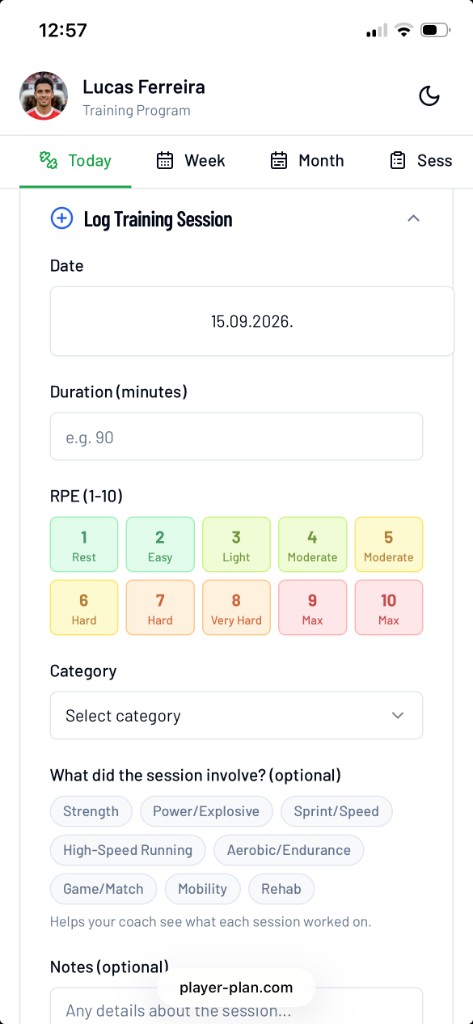
Session load is duration × RPE. Write it down. A player who sat out the last 20 minutes is not the same as a player who did extras. A goalkeeper’s “training” is not a midfielder’s.
Ask for the score close to the session, not three days later. Memory inflates or sanitises RPE. If they forget, a same-evening text is enough: “How long, and what would you give it out of 10?” That single habit is more valuable than a clever spreadsheet.
What this does not include: asking the player to guess GPS metres, downloading an app, or waiting for the club physio to email you. Friction kills the data. If they will not log it, you are programming blind, and you should treat every gym session as if the club day was moderate-to-hard until proven otherwise.
Once you have 3–4 weeks of club sessions, patterns appear. Most clubs are boring in a useful way: MD-4 is often the high-intensity pitch day, MD-1 is taper, Tuesday extras hit the same players. You start planning proactively instead of rewriting Wednesday night.
Managing that log across 8–12 players in WhatsApp is where most independent coaches stall. A shareable player link — the kind PlayerPlan uses, no app download — lets the footballer log club duration, RPE, and a label in about 30 seconds, so the session is on your week before you warm them up.
Step 2: Put Club Work on the Same Calendar as Yours
The match day minus framework only works if “MD-2” means everything that happened two days before the match, not just the session you wrote.
Build the week as one picture:
| Day | Club (typical) | Your default | After you see club load |
|---|---|---|---|
| MD+1 | Off / recovery | Off | Stay off. Do not “sneak in” Nordics. |
| MD+2 | Light pitch or off | Reload / movement quality | Keep if club was easy; shorten if they played 90. |
| MD-4 | High-intensity pitch or SSG | Heavy strength (if this is your gym day) | If club RPE ≥ 7 for 70+ min, cut a set or move the gym. |
| MD-3 | Tactical / mixed | Heavy strength (preferred gym day) | Best window for most independent players. |
| MD-2 | Speed / tactical | Low-volume power or skip | Skip gym speed if the club already did HSR or RSA. |
| MD-1 | Activation | Nothing, or 15 min if they are a sub | Do not add eccentric lower body. |
| MD | Match | Match | Minutes played decides next week, not your plan. |
Two rules sit under that table.
The match is the main session of the week. Your gym work exists to prepare for it or recover from it. If the club already filled a quality (speed on MD-2, high-intensity on MD-4), you do not double it.
Minutes played rewrite the next microcycle. A 90-minute starter and a 12-minute sub do not share an MD+2. We cover the starter vs bench split in the MD-minus piece; around club training the same logic applies to training minutes. The player kept for extras on Thursday is not the player who was sent home at 60.
Internal link this to in-season training: the minimum effective dose only stays “minimum” if you counted the club dose first.
Step 3: Keep, Cut, Move, or Skip
The plan is a first draft. The decision is the coaching.
Use four options, in this order:
1. Keep. Club session was easy or complementary (walk-through, video, light possession). Your MD-3 strength stays as written.
2. Cut. Club session was moderate-to-hard but you still need the gym quality. Drop a set across the board, remove the most expensive eccentric (Nordics, heavy RDLs, deep split squats), keep intensity on 2–3 compound lifts. A 3×5 squat at 85% with full rest is cheaper than a 5-exercise lower body circuit with 60-second rests.
3. Move. The quality still needs to happen this week, just not today. Slide the heavy session 24 hours if the match calendar allows. Never slide it onto MD-1. Never slide high-speed running onto a day that already had it.
4. Skip. Club already delivered the stimulus, or the player is a red flag (poor sleep, lingering hamstring, ACWR climbing through 1.3). Skipping is a decision, not a failure. The best gym session some weeks is the one you do not run.
Decision rules I actually use
| If this happened at the club | Then in the gym |
|---|---|
| SSG or match-simulation, RPE ≥ 7, 60+ min, same day or previous afternoon | ✗ No additional COD, no extra deceleration work, no dense lower-body circuit |
| High-speed running or RSA in training | ✗ No flying sprints, no extra HSR intervals |
| Club already did a “gym circuit” | Do not repeat it. Do the quality they missed (usually heavy or eccentric). |
| Player kept for extras / individual finishing | Treat as a second session. Cut yours. |
| Goalkeeper diving session | Upper-body and landing-load caution; they still need lower-body strength, just not the same accessory list as a 9 |
| Wellness: sleep ≤ 2/5 or hamstring tightness noted | Drop eccentrics; keep isometrics or skip |
| Two matches in 7 days | Forced deload. Activation only. Protect both matches. |
The independent S&C coach’s edge is not a fancier exercise. It is making this call for this player, while the club runs one session for 18 people.
A Sample Week: Academy Midfielder, Saturday Match
Player: 18-year-old central midfielder. Club training Mon / Tue / Thu / Fri. Match Saturday. You see him Wednesday evening. This is how the week looks once club load is logged — not how it looked in your template on Sunday.
Monday (MD+2), club: 60 min possession + passing. RPE 4. Load 240.
Your call: optional 25-minute reload if he is stiff (goblet squat 3×8, single-leg RDL 3×6, Copenhagen 2×6). Many weeks you skip it.
Tuesday (MD-4), club: 80 min SSG + tactical. RPE 8. Load 640. Notes: “4v4, lots of pressing.”
Your call: that is the high-intensity day. Do not add a conditioning top-up. If you had planned speed work Tuesday, it moves or dies.
Wednesday (MD-3), you: 50-minute strength. This is the individual session — about 24 hours after Tuesday’s SSG, not stacked on it.
- A1 Trap-bar deadlift 4×4 @ 82–85%, 2.5 min rest
- B1 Rear-foot elevated split squat 3×5 each, 90s
- B2 Bench or weighted pull-up 3×5
- C1 Nordic hamstring 2×4 (controlled range, quality reps)
- C2 Copenhagen short-lever 2×6 each
- D Anti-rotation + calf raise, 2 rounds
What this session does not include: extra HIIT, extra agility ladders, 12-exercise circuits, anything that turns rest periods into conditioning. The club already conditioned him yesterday.
Thursday (MD-2), club: 70 min tactical + some high-speed. RPE 6. Load 420.
Your call: no gym. If he is a wide player who got almost no sprint exposure, a 4×20m fly on Friday is the exception, not the rule.
Friday (MD-1), club: 45 min activation. RPE 3.
Your call: nothing from you.
Saturday: 78 minutes. Next week’s MD+1 is recovery, and Wednesday’s deadlift drops to 3×3 if wellness is flat.
That midfielder got one individual gym session that the club will not run: heavy hinge, single-leg strength, dosed Nordics. Everything else was constraint, not addition. That is how you program soccer players in the real week, not the blank one.
Building the week as one picture. PlayerPlan’s player-page load monitoring folds club-logged sessions into the same ACWR as your gym session load. You decide to cut a set because you can see Thursday, not because the player “looked tired” at 7pm. Club nights do not appear as sessions on the program designer grid.
Five Mistakes Independent Coaches Make
Guessing the club week. “They usually train Tuesday and Thursday” is not data. Cups, international call-ups, and a coach in a bad mood change the week. Log it.
Writing one gym plan for every player at the same club. The starter, the unused sub, and the player who did extras did not have the same Tuesday. Position demands differ too — a 9 and a 6 should not share accessory volume just because they share a club.
Doubling a quality. Club did RSA on Thursday; you programmed flying sprints on Thursday night because “speed is on MD-2.” Pick one.
Using the gym as a second conditioning session. Short rest, supersets of squats and jumps, “finishers.” You are adding the exact fatigue the club already provided, and missing the qualities they never train.
Treating a skipped session as a lost week. Availability is the performance metric. A player who arrives at Saturday able to sprint is a better outcome than a completed program that left them heavy.
Key Takeaways
- Club training is load. If it is not on the calendar, your program is a guess.
- Three fields are enough: duration, RPE, label. Session load is the product of the first two.
- Map club sessions onto MD-minus, then keep, cut, move, or skip.
- Individual gym work exists to supply what the squad session will not: force, eccentric control, rest.
- Minutes played and extras change the next week more than your template does.
- The independent coach’s advantage is per-player decisions. That only works with per-player data.
FAQ
How do I program soccer players around club training if they never remember RPE?
Ask the same evening, in the same format, every time. “Minutes and a number out of 10.” If they still blank, default the session to RPE 6–7 for a normal club night and RPE 8–9 for SSG or match-simulation, then confirm later. Consistency beats precision in the first month.
Should I talk to the club coach?
Yes, if you can do it without looking like a rival. Frame it as load, not philosophy: you want to complement their week. Many will share the microcycle. Many will not. When they will not, the player log is the system — see the communication note in our programming guide.
What if the player trains with the club seven days a week?
Then your volume has to collapse. One 40-minute strength session in the MD-3 window, or none in a two-match week. Individual work still matters; it just cannot be a second full program.
Is GPS necessary to do this well?
No. GPS is better for high-speed metres and accelerations. Session-RPE training load is enough to stop the obvious mistakes: stacking hard on hard, doubling speed, ignoring extras. Use GPS when you have it; do not wait for it.
How is this different from just following MD-minus?
MD-minus tells you when qualities fit. Club logging tells you whether the club already trained that quality. Without both, you are following a calendar that only contains your sessions.
The whole job is seeing the week the player actually lived, then writing the one session they still need. PlayerPlan was built for that: players log club training from a link (date, duration, RPE, label, notes), you see session load and ACWR on the player page with your gym work, and you share the adjusted session back to their phone. Start a 30-day trial at player-plan.com.