
Programming
Position-Specific Strength Training for Soccer
Position specific strength training for soccer: one shared gym menu, then a different finish by role. A centre-back and a full-back did not play the same match.

Mario Jovanovic
S&C coach · 9 min read
Position-Specific Strength Training for Soccer
Tuesday lower body. The same trap-bar work goes to the centre-back who contested every cross and the full-back who arrived in both boxes. Same shirt. Not the same match. Call it position specific strength training soccer: one shared lift menu, then a different 10-minute finish, and a short list of what you will not add.
What is position specific strength training for soccer? Gym work built from what that role spends in a match: fast running, short sprints, braking, and jumping. The big lifts stay the same. The finish changes. So does the work you leave off the sheet.
The position is the first sort. The player is the second. Two full-backs still differ by minutes, a hamstring history, and the club session you did not see. When professionals changed role, the positional average explained only part of the change in match output — about 44–58% in one study. The rest stayed with the player (Altmann et al., PLOS One). Use the finish below as the default, then edit it. That edit is individual training.
A wing-back in a back three is closer to a wide player than to a centre-back. A number 6 who never leaves the pocket is closer to a centre-back’s running bill than to a box-to-box midfielder. Program the job they actually did on Saturday, not the word on the teamsheet.
What the Role Actually Spends
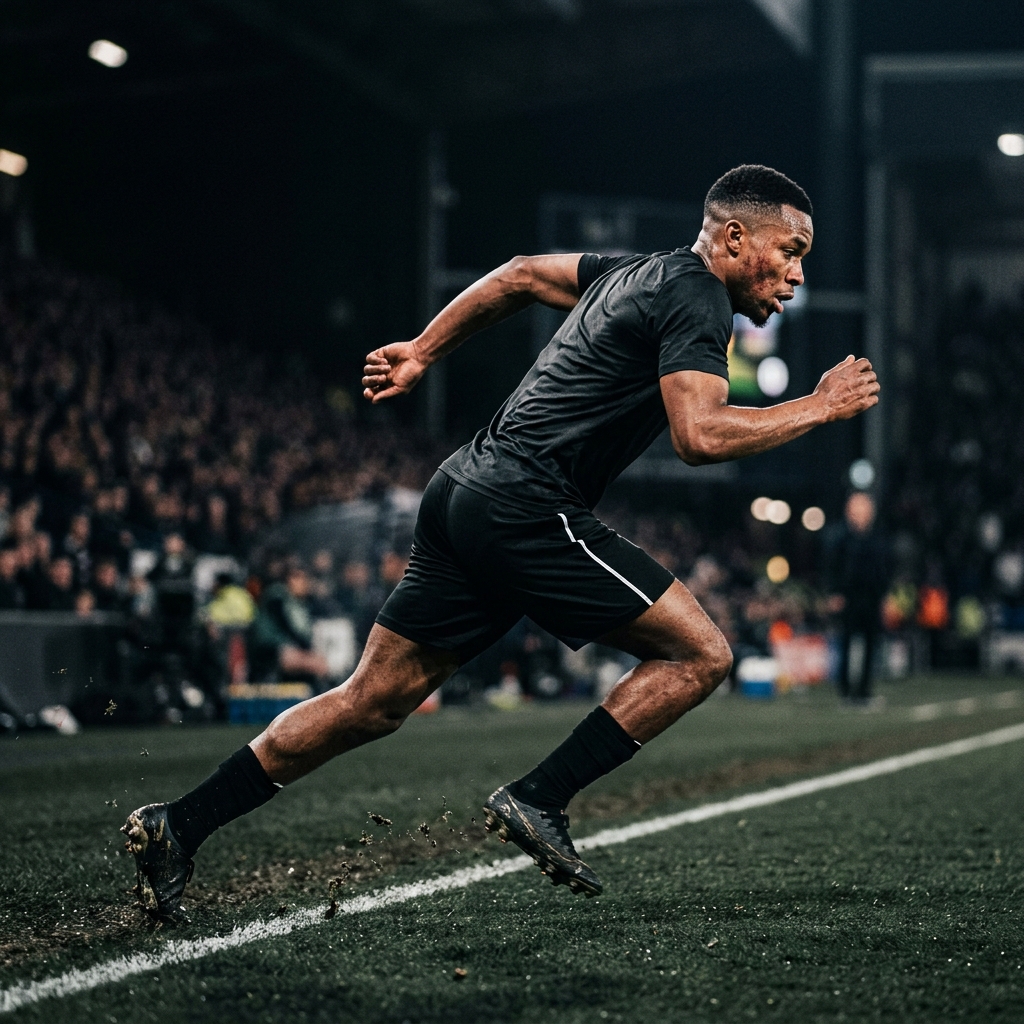
In elite men’s matches, high-intensity running — everything at or above 14.4 km/h — ranks the same way every time you look: wide midfielders, then central midfielders, full-backs, attackers, and centre-backs last. Wide midfielders covered about 1,200 m more of that running than centre-backs. Centre-backs still covered about 10 km. They do less of the fast stuff. They do not get a lighter barbell (Bradley et al., JSCR, 2010).
Check the band on your own GPS before you copy those metres. A report that calls “high speed” anything over 19.8 or 25 km/h is a different bin. Compare players inside one system.
The hard efforts are short. Wide players and full-backs do more of the braking and the sharp turns. A bigger high-speed total is not a reason to write 60-metre repeats. It is a reason to keep the brakes strong and to stop adding running the club already did.
A lab screen of 289 Belgian first-division players matches that picture well enough to pick a finish. Full-backs and midfielders had the higher aerobic scores. Strikers were the fastest over the first 10 m. Centre-backs and goalkeepers jumped higher than the other roles (Boone et al., JSCR, 2012).
The women’s game splits the same way, on different speed zones. At the 2023 World Cup, wide midfielders and wide forwards did clearly more running above 19 km/h than centre-backs and the central midfield roles. Centre-forwards led the sprinting, and they did not all look alike — a runner in behind and a target nine are different jobs. Do not drop a men’s 25 km/h sprint zone onto a women’s roster and call the ranking a position profile (FIFA Training Centre, Women’s World Cup 2023).
The Lifts Everyone Keeps
A heavy half squat tracked sprinting and jumping in a Champions League squad, at a bit over twice body mass, and it did not come with a worse aerobic score. That squad did not split by position. The study is a correlation, not a trial that assigns programs by shirt number. It is still the clean reason the main lifts stay on every sheet (Wisløff et al., BJSM, 2004).
In season, one gym day is enough when the club owns the pitch. Put it on MD-4 or MD-3. The calendar is the match-day-minus framework. If the club session was already long and hard, cut a set. The in-season guide covers that call. These sets are a coaching menu, not a published protocol.
| Slot | Exercise | Dose | Why it stays |
|---|---|---|---|
| A1 | Trap-bar or safety-bar squat, or rear-foot-elevated split squat | 3–4 × 3–5, about 2 reps in reserve, rest 2–3 min | Strength under the sprint and the jump |
| A2 | Romanian deadlift or single-leg RDL | 3 × 5–6 | Hinge for posture and braking |
| B | Heavy calf raise | 3 × 6–8 | Every role hits the ground all match |
| C | Nordic hamstring or slider leg curl | Maintenance dose | Wide roles live here; centre-backs still sprint in the hard spells. Progression: Nordic programming |
| D | Side plank or Pallof press | 2–3 × 20–30 s each side | Trunk for duels and cuts. Stop before it becomes a core class |
Goalkeepers keep the squat, the hinge, and the calf. They still need hamstrings. They do not need a winger’s sprint finish.

Position-Specific Strength Training for Soccer: The Finish
Eight to twelve minutes. Pick one finish. Leave the others off, even if the sheet looks short.
Centre-back. Three sets of three countermovement jumps, or stick the landing if set pieces already gave them a lot of jumping. If they barely played, add four 10 m accelerations with full rest. Skip the 30 m repeats meant to catch them up to the full-back. Their match asked for contact and jumping. Leave the heavy sets on.
Full-back, wing-back, and wide midfielder. Three sets of three trap-bar jumps or broad jumps, then four 20 m runs that speed up and brake in the last three steps. The match already gave them the fast metres and the turns. The gym gives them the strength to survive the brake. On a day the club already ran that distance, skip the runs and keep the jumps. Bike intervals on top of a hard club session are how you add fatigue with no new quality. Sequencing that week is concurrent training.
Central midfielder. Often you stop after the main lifts. The position already does the most running. Add four 10 m accelerations only when minutes were low or the club week was light. A 6 who sits in front of the back four follows this rule. A midfielder who plays as a wide eight follows the wide finish.
Forward. Five standing-start 10 m sprints, full rest, if they are the runner. If they are the target — headers, hold-up, the aerial duels — give them the centre-back jump finish instead. If you cannot tell which nine you coach, you have a label, not a program.
Goalkeeper. Lateral bounds, three sets of three each side, and a horizontal press, three sets of five. They jump with the centre-backs and they do not pay the full-back’s running bill. A dive-and-land practice belongs here when the week has room. Outfield sprints do not.
Youth players can use the same menu shape. Senior match averages are not a licence to load a U16 like a 28-year-old full-back. Movement quality still comes first (youth strength training).
One shared session and five finishes is easy to design and annoying to send five ways on WhatsApp. PlayerPlan’s session builder keeps the skeleton, swaps the finish for one player, and gives them a link on their phone.
One Week, and the Mistakes That Waste It
A second gym day only belongs in a real gap between matches, and only if they look ready for it. MD-1 is activation for every role. Do not sneak Nordics in because the heavy day got skipped.
| Day | Centre-back | Full-back / wide | Central midfielder | Forward | Goalkeeper |
|---|---|---|---|---|---|
| MD-4 or MD-3 | Shared menu + jumps | Shared menu + jumps and brakes | Shared menu, no extra running | Shared menu + 10 m starts, or jumps if they are the target | Shared lower + lateral bounds and a press |
| MD-2 | Short accelerations only if minutes were low | Short accelerations if the week was light on sprinting | Skip if the club session was already long | Accelerations for the runner; jumps for the target | Lateral power, not outfield repeats |
| MD-1 | Activation | Activation | Activation | Activation | Activation |
If they played midweek, the heavy day may already be gone. Cut a set or drop the finish. The centre-back who played 12 minutes still should not copy the full-back’s brake session, and the full-back who played 90 still should not copy the centre-back’s jumps-only day. Minutes are the next edit, in the individual training guide.
Four ways the single sheet goes wrong:
- Reading low fast-running as low need. Centre-backs cover about 10 km and jump more. Take the extra sprints off. Leave the bar on.
- Adding running because the GPS number was big. Wide players already did that work. The gym gap is strength and braking.
- Mixing speed bands. A 14.4 km/h total and a 19.8 km/h total are different lists. Women’s zones are different again. Compare inside one report.
- Stopping at the position. The finish is the default. Minutes, pain, and club load still change it.
Key takeaways
- One shared gym menu. A different 10-minute finish. A list of what you will not add.
- Wide roles and full-backs do more fast running and more braking. Centre-backs and goalkeepers jump more. Strikers who run in behind live in the first 10 m.
- Keep the speed band next to any number you copy, and do not use men’s sprint zones for a women’s squad.
- The heavy lifts stay for everyone. Position is the first sort. The player is the second.
FAQ
What is position specific strength training for soccer?
Shared strength work, then a finish that matches the role: jumps and fewer extra sprints for centre-backs, braking for full-backs and wide players, little or no added running for central midfielders, 10 m starts or jumps for forwards depending on the type of nine, and lateral work plus a press for goalkeepers.
Should every position have a completely different program?
No. Squat or split squat, hinge, calf, a bit of trunk, and some Nordic or slider work belong on almost every sheet. If your “position programs” share no exercises, you have written five hobbies.
Do centre-backs need less strength because they run less?
They do less fast running. They still cover about 10 km, and they jump more than the wide roles. Take running volume off the gym day. Leave the heavy sets on.
Does this hold for the women’s game?
Yes, with different speed thresholds. Wide roles do more high-intensity running than centre-backs, and centre-forwards are not one type. A men’s 25 km/h sprint zone will mis-rank a women’s squad.
References
- Bradley, Di Mascio, Peart, Olsen & Sheldon (2010). High-intensity activity profiles of elite soccer players. Journal of Strength and Conditioning Research, 24(9), 2343–2351. https://doi.org/10.1519/JSC.0b013e3181aeb1b3
- Boone, Vaeyens, Steyaert, Vanden Bossche & Bourgois (2012). Physical fitness of elite Belgian soccer players by player position. Journal of Strength and Conditioning Research, 26(8), 2051–2057. https://doi.org/10.1519/JSC.0b013e318239f84f
- Wisløff, Castagna, Helgerud, Jones & Hoff (2004). Maximal squat strength, sprint, and vertical jump in elite soccer players. British Journal of Sports Medicine, 38(3), 285–288. https://pmc.ncbi.nlm.nih.gov/articles/PMC1724821/
- FIFA Training Centre. Setting physical benchmarks across positions — FIFA Women’s World Cup 2023. https://www.fifatrainingcentre.com/en/game/tournaments/fifa-womens-world-cup/2023/post-tournament-analysis/physical-analysis/part-3-setting-physical-benchmarks-across-positions.php
- Altmann et al. (2021). Match physical performance in soccer: position or player specific? PLOS One. https://journals.plos.org/plosone/article?id=10.1371/journal.pone.0256695
Ready to run one gym menu and a different finish per player? PlayerPlan gives independent S&C coaches a session builder and a link each footballer opens on their phone. Build the heavy day once, then change the last 10 minutes by role. Start a 30-day trial (full Pro features, 3 players).
Ready to ditch the spreadsheets?
Session building, periodization, load monitoring and no-login player sharing — built for football S&C coaches.
Start your free 30-day trialPro features, AI included. No credit card.